Herringbone vs Chevron Flooring — What's the Difference?
If you've been searching for patterned flooring, you've almost certainly come across both these terms. And if you're not entirely sure what separates them, you're not alone. Herringbone and chevron are used interchangeably so often — even by people who should know better — that the confusion has become completely understandable.
They're not the same thing. They look similar at a glance, they're both based on the same zigzag concept, and they suit many of the same rooms and interior styles. But the difference between them is meaningful, and knowing it will help you make a better decision.
The simplest way to understand the difference
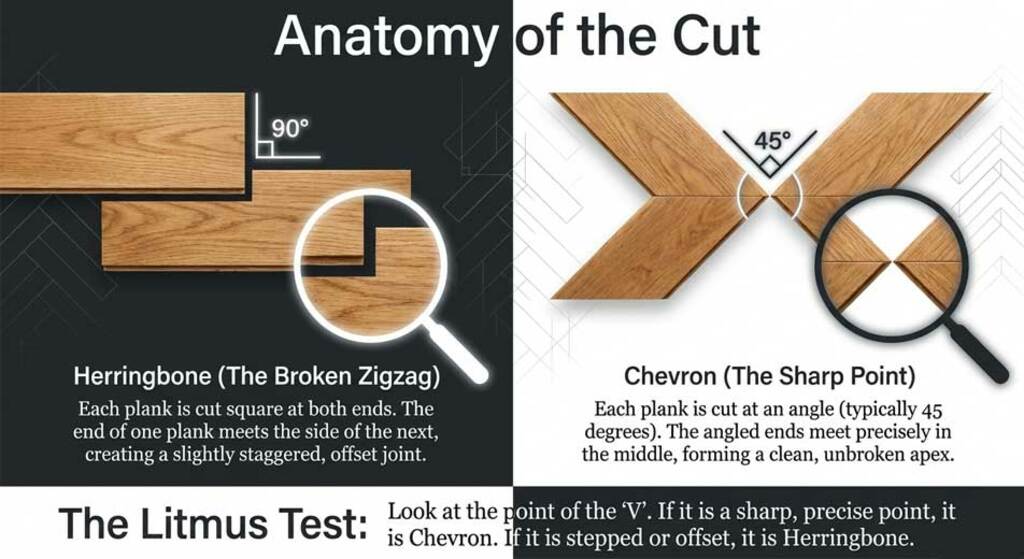
Both patterns are made from rectangular planks laid at angles to create a zigzag effect across the floor. The difference is in how the planks meet each other.
In herringbone, each plank is cut square at both ends — a standard rectangular shape. When laid, the end of one plank meets the side of the next, creating a broken zigzag where the joint between planks is offset. Look closely at a herringbone floor and you'll see the V shapes don't have clean, sharp points — they're slightly staggered where the planks connect.
In chevron, each plank is cut at an angle at both ends — typically 45 degrees, though this varies. When laid, the angled ends of two planks meet precisely in the middle, forming a clean, sharp point at the top of each V. The result is a continuous, unbroken zigzag that runs across the entire floor.
The easiest test: look at the point of the V. If it's sharp and precise — chevron. If it's slightly broken or offset — herringbone.
A brief history of both patterns
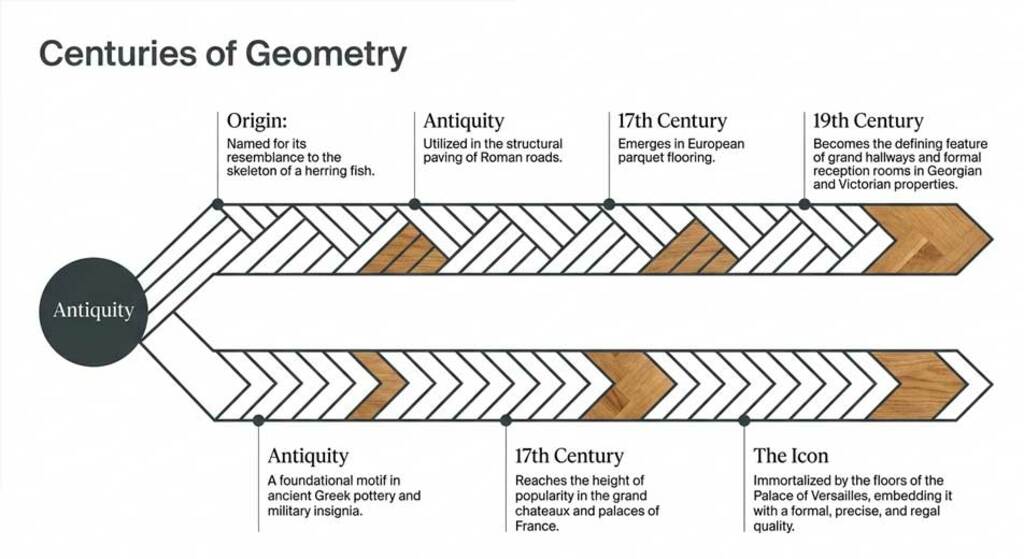
Neither of these is a new idea. Both patterns have been used in flooring, tiling, brickwork, and textiles for centuries.
Herringbone gets its name from its resemblance to the skeleton of a herring fish — the spine running down the middle with bones angling out on either side. It was a common pattern in Roman road paving and has appeared in European parquet flooring since at least the 17th century. It became particularly associated with grand hallways and formal reception rooms in Georgian and Victorian properties.
Chevron has a similarly long history, appearing in everything from ancient Greek pottery to military insignia. In flooring it became popular in the grand chateaux and palaces of France — Versailles is perhaps the most famous example — and has always carried a slightly more formal, precise quality than herringbone.
Both patterns fell out of fashion in the mid-20th century when wall-to-wall carpet dominated British interiors. Their return over the last fifteen years has been driven partly by a renewed interest in period properties and craftsmanship, and partly by the fact that both patterns simply photograph beautifully — which matters enormously in an era where home interiors are shared constantly on social media.
Which pattern creates a stronger visual effect?
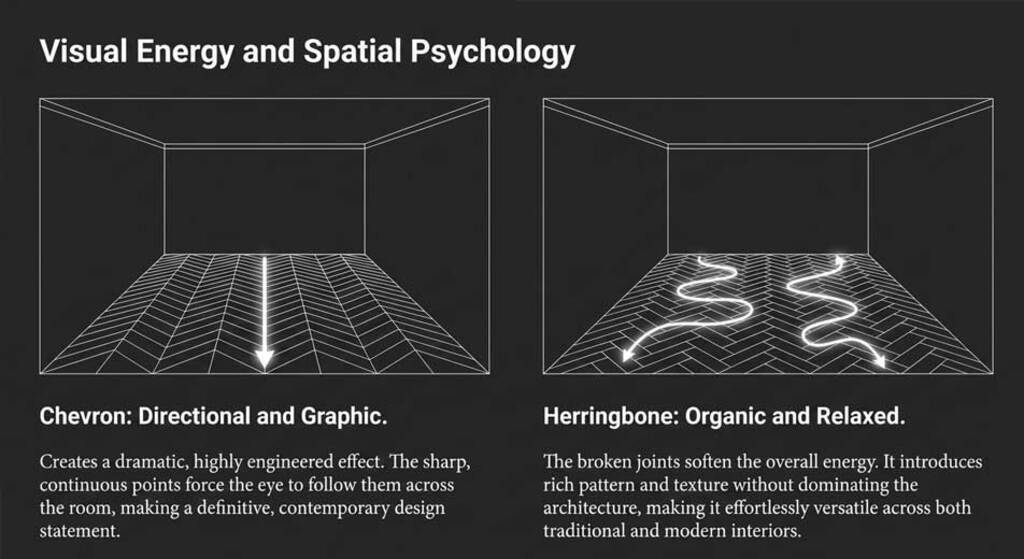
Chevron tends to create a slightly more dramatic, directional effect. Because the V points are sharp and continuous, the eye follows them naturally across the room. This can make a space feel longer or wider depending on the direction the pattern runs.
Herringbone is a little more relaxed in its energy. The broken joint softens the overall effect, giving it a more organic, less formal quality. It's arguably more versatile — it works in both traditional and contemporary interiors without feeling out of place in either.
If you want something that makes an immediate statement, chevron has the edge. If you want something that adds pattern and interest without dominating the room, herringbone is typically the safer choice.
Which rooms suit each pattern?
Hallways
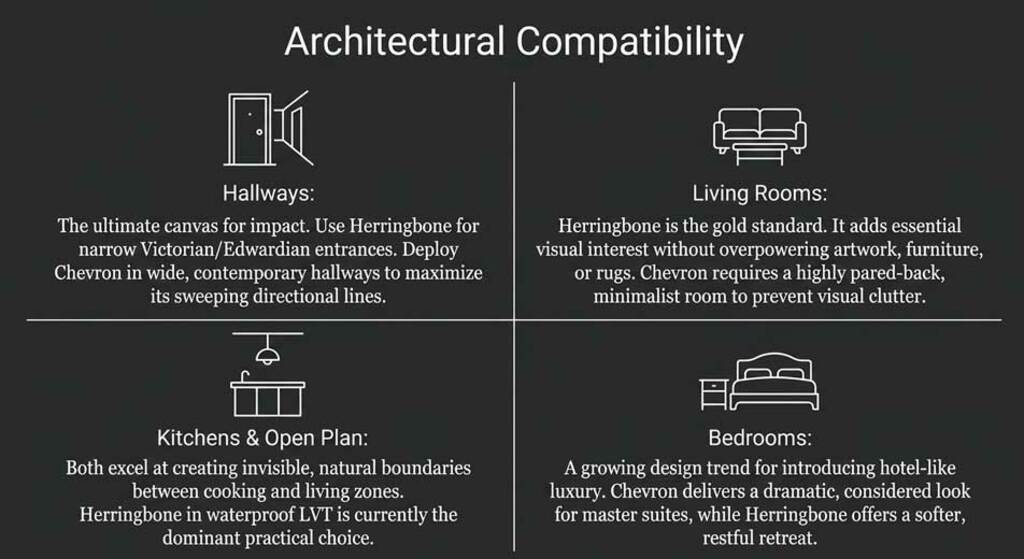
Both patterns are outstanding in hallways — this is where patterned flooring has the most impact and where guests notice it first. Herringbone is the more traditional choice and works beautifully in Victorian and Edwardian properties where the hallway is narrow. Chevron suits wider, more contemporary hallways where its directional quality can really show.
Living rooms
Herringbone is typically the more popular living room choice. It adds visual interest without making the floor the only thing you see when you walk in — which matters in a room where you also want furniture, art, and people to draw the eye. Chevron in a living room is more of a design statement and works best when the rest of the room is relatively pared back.
Kitchens
Both work well in kitchens, particularly open-plan kitchen-diners. The pattern creates a natural visual boundary between cooking and living areas even without a physical division. Herringbone in engineered wood or LVT is particularly popular here — it combines the visual appeal of a traditional pattern with the practical durability needed in a kitchen environment.
Bedrooms
Patterned flooring in bedrooms is less common but growing in popularity, particularly in master bedrooms where it adds a hotel-like quality. Both patterns work here — chevron for a more dramatic, considered look, herringbone for something slightly softer and more relaxed.
Period properties
If you have a Victorian, Edwardian, or Georgian property, herringbone parquet or engineered herringbone oak is almost always the right choice. It's historically appropriate, it complements period features like fireplaces, cornicing, and sash windows, and it adds genuine character that straight plank flooring simply can't replicate.
Which materials are herringbone and chevron available in?
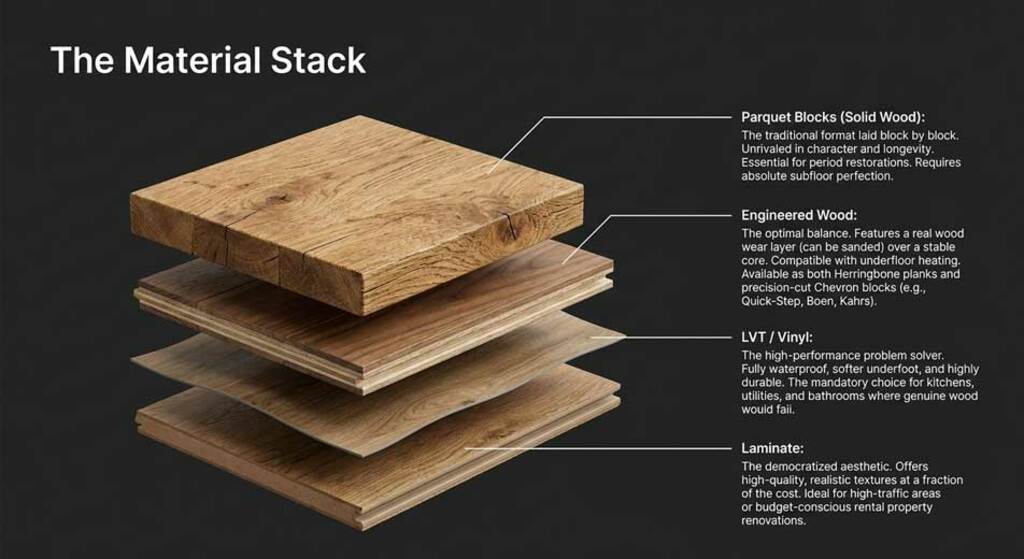
This is where the conversation becomes more practical. Both herringbone and chevron are available across a range of materials, each with different price points, performance characteristics, and installation requirements.
Engineered wood
The most popular choice for homeowners who want the genuine look and feel of real wood with the added stability of an engineered construction. Both herringbone and chevron are available in engineered oak, compatible with underfloor heating, and can be sanded and refinished depending on wear layer thickness. Available from leading brands including Quick-Step, Boen, Kahrs, and Elka.
👉 Browse engineered herringbone flooring
Engineered parquet chevron
If you want the sharpness of a chevron pattern in a real wood format, engineered parquet chevron blocks are the place to start. The angled blocks are precision cut to create that clean, unbroken V point that defines the chevron pattern — and because they're engineered rather than solid, they're more dimensionally stable and suitable for use with underfloor heating.
👉 Browse engineered parquet chevron flooring
Parquet herringbone blocks
The traditional format — individual solid wood blocks laid by hand. The most labour-intensive and characterful option, associated with period properties and formal interiors. Requires skilled fitting and thorough subfloor preparation, but the result is exceptional and will last a lifetime.
👉 Browse parquet herringbone flooring
Laminate
A practical and affordable way to achieve either look without the cost of real wood. Modern laminate herringbone has improved dramatically in quality and realism over the last decade. A good choice for rental properties, high-traffic areas, or any room where budget is the primary consideration.
👉 Browse herringbone laminate flooring
Vinyl and LVT
The most practical option for kitchens, utility rooms, and anywhere that needs a fully waterproof floor. Both herringbone and chevron are available in LVT — giving you the visual warmth of a patterned wood floor with the performance of a vinyl product. Softer underfoot than laminate, easy to clean, and completely water-resistant. If you want patterned flooring in a kitchen or bathroom, this is almost always the right material to start with.
👉 Browse vinyl herringbone flooring
👉 Browse vinyl chevron flooring
Does the direction of the pattern matter?
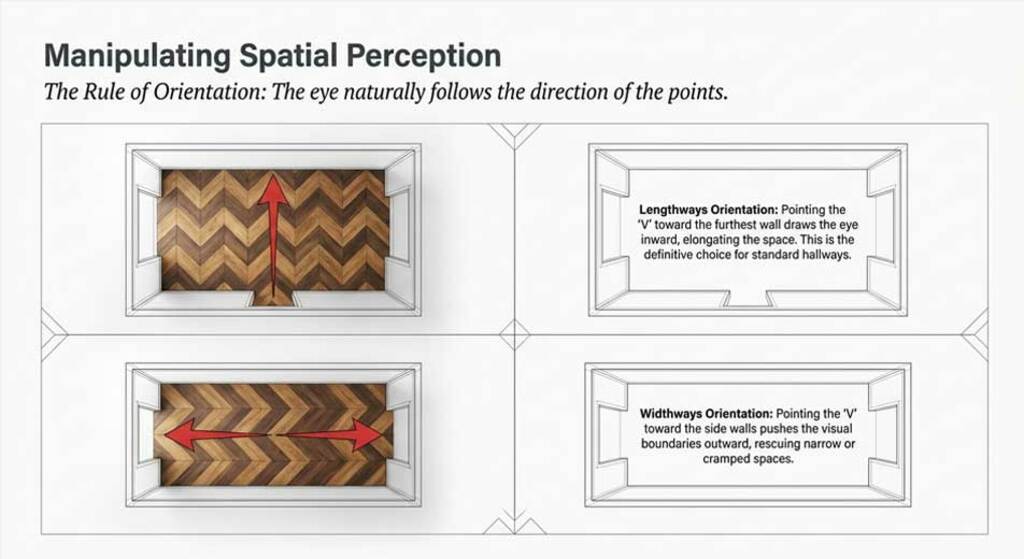
Yes — and it's worth thinking about before you commit.
Both herringbone and chevron can be laid in different orientations relative to the room. The most common approach is to run the pattern lengthways down the room — so the V points towards the far wall. This tends to make the room feel longer.
Running the pattern widthways — so the V points towards the side walls — can make a narrow room feel wider.
In hallways, running the pattern lengthways is almost always the right choice. In square rooms, either direction works. Your fitter will usually have a strong opinion on this based on the proportions of the space — it's worth asking before installation begins.
Installation — is one harder to fit than the other?
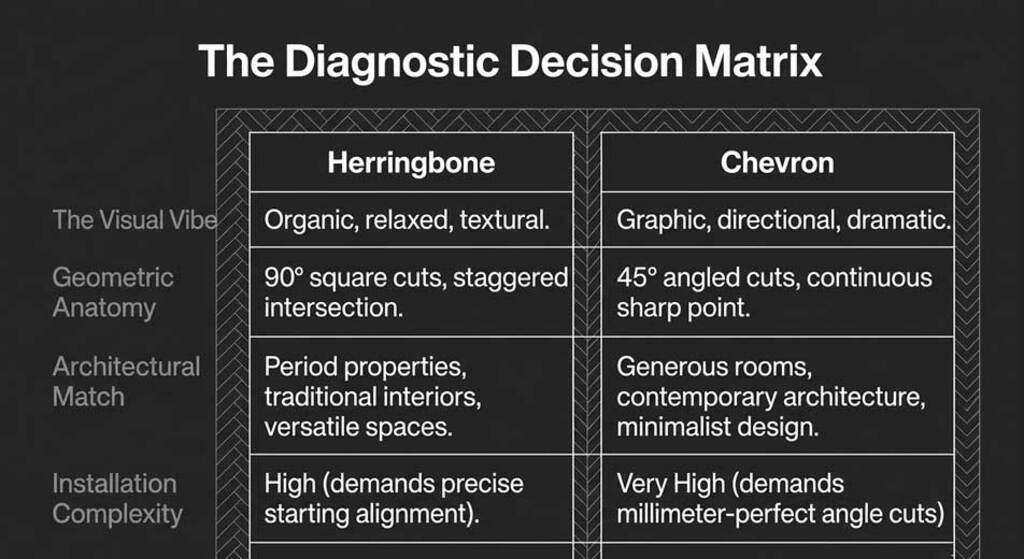
Both patterns are more complex to fit than straight plank flooring. They require more precise measurement, more cuts, and more time. Expect installation to take longer and cost more than a standard plank floor of the same material.
Chevron is generally considered slightly more complex than herringbone because of the angled cuts required at each end of every plank. Those angles need to be precise — if they're even slightly off, the V points won't meet cleanly, and the pattern will look wrong. It's not a job for an inexperienced fitter.
Herringbone is more forgiving by comparison, but it still requires careful planning — particularly around the starting point, which determines how the pattern falls across the whole room.
We offer a fitting service for all engineered and solid wood flooring. If you're unsure about installation, it's always worth getting a professional involved.
The honest summary
Choose herringbone if:
- You have a period property or traditional interior
- You want pattern without an overpowering visual effect
- You're laying in a hallway, kitchen, or living room
- You want the widest choice of materials and price points
- You prefer something slightly more relaxed and organic in feel
Choose chevron if:
- You want a sharper, more graphic, more contemporary look
- Your room is generous enough to carry a stronger visual statement
- You're happy to invest in skilled fitting
- You want something a little less common
And if you genuinely can't decide — order samples of both. See them in your room, in your light. The right answer usually becomes obvious within about ten minutes.
Want to see both patterns in person before you decide? Visit our London showroom — we stock herringbone and chevron across all four materials and our team can help you find the right fit for your project. Call us on 02088309787 or message us on WhatsApp.