How to Choose Herringbone Wood Flooring
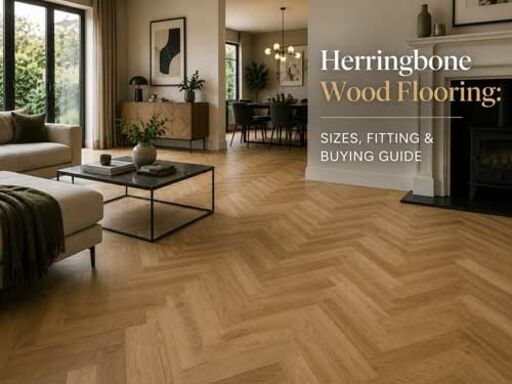
Herringbone gets its name from the fish it resembles: rectangular blocks laid at 90 degrees to each other in a zigzag rather than in straight runs. It's one of the oldest wood flooring patterns still fitted in UK homes, and it's also one of the least forgiving to get wrong, so it's worth understanding what makes it different before you order.
Herringbone vs chevron
People often use these terms interchangeably, but they're different patterns. Herringbone uses square-cut ends, so each block sits at a right angle to the next, creating the classic zigzag. Chevron Engineered Flooring uses angled ends (usually 45 degrees) that meet in a continuous point, giving a more uniform arrow shape. Chevron needs more precise cutting and generally costs more in labour. If your original inspiration image shows a continuous unbroken "V", that's chevron, not herringbone. Worth checking before you order, since returns on cut parquet can be costly.
Solid or Engineered
Both are available in herringbone. Solid wood blocks are a single piece of timber through their full thickness, which means they can be sanded and refinished several times over their life, but they move more with humidity and are less suited to rooms with underfloor heating. Engineered herringbone has a real wood top layer bonded to a plywood or HDF base, which makes it more dimensionally stable and generally the safer choice over underfloor heating or in a solid-floor London flat with less humidity buffering than an older property. Check our engineered parquet flooring range and solid parquet flooring range to compare what's currently in stock.
Board size and how it changes the look
Herringbone blocks are sold in fixed length-to-width ratios, usually 2:1 (a 400mm block is 100mm wide, for example). Smaller blocks give a busier, more traditional look and suit smaller rooms; longer blocks read as more contemporary and work well in open-plan spaces. There's no single correct size, but it's worth laying a sample block against your room's longest wall before ordering, since the pattern reads very differently at floor level than it does in a product photo.
Order more than the room measurement
This is the mistake that catches people out most often. Because every block is cut and fitted at an angle, herringbone wastes more material than a standard plank floor laid straight. Budget for roughly 10-15% over your measured floor area to cover angle cuts, edge pieces, and breakages, more if the room has a lot of alcoves, chimney breasts, or door thresholds to work around. Ordering short partway through a fit is a common cause of delayed projects, particularly with batch-dyed or limited-run colours where a later batch may not match exactly.
Get the subfloor right before anything else
Herringbone is less forgiving of an uneven subfloor than a straight-laid floor, because the blocks are shorter and any dip or hump under the pattern shows up as a visible kink in the zigzag rather than blending in along a long plank. As a general rule, aim for flatness within about 3mm over a 2 metre straight edge before fitting. On solid concrete subfloors, check moisture levels too; a damp subfloor under wood flooring is one of the most common causes of cupping and gaps months after fitting. Our damp proofing and levelling range covers both.
Choosing a fitting method
Herringbone can be floated, but most fitters recommend glue-down fitting for anything other than click-system engineered herringbone designed specifically for floating. Gluing keeps every block locked in place, which matters more here than on a straight floor because there's no long continuous plank holding the pattern together end to end. If you're floating a click herringbone product, use a good quality underlay rated for the product; see our underlay and insulation range. For glue-down installs, match the adhesive to the subfloor type from our adhesives range rather than defaulting to whatever's cheapest, since the wrong adhesive on a damp or slightly flexing subfloor is a common cause of blocks lifting later.
Setting out the pattern
Fitters typically work from a centre line rather than starting at a wall, since most rooms aren't perfectly square and starting from a wall means the pattern drifts out of true by the time it reaches the far side. A chalk line is snapped down the centre of the room (or centred on a focal point like a fireplace or bay window), and the herringbone is built outward from there in both directions, with the border rows cut to fit the walls last. This takes longer than a straight lay and is one of the reasons herringbone fitting costs more in labour than plank flooring of the same material.
Finish options
Herringbone is available oiled, lacquered, or unfinished, the same choice as any other real wood floor. Oiled finishes (Osmo, Junckers and similar) sit into the wood and are easier to spot-repair on individual blocks if one gets damaged, which suits a pattern floor well since you can often refresh a single block rather than the whole room. Lacquered finishes give a tougher, more uniform sheen and are lower maintenance day to day. See our hardwax and oil range and floor lacquers range for what's in stock.
Getting a look at it before you commit
Because herringbone is expensive to get wrong and hard to judge from a screen, it's worth ordering a few free samples and laying them out in a rough cross pattern on the actual floor, in the room's natural light, before ordering. If you'd rather not fit it yourself, our fitting service covers herringbone installation across London.
Frequently asked questions
How much extra herringbone flooring should I order for wastage? Around 10-15% above your measured floor area, more for rooms with lots of cuts around alcoves or thresholds.
Is herringbone flooring suitable for underfloor heating? Engineered herringbone generally is, provided the product is rated for it and installed to the manufacturer's guidelines. Solid wood herringbone is more sensitive to the temperature and humidity changes underfloor heating creates.
Can I float herringbone flooring instead of gluing it down? Only if the product is a click system specifically designed for floating. Most herringbone, especially solid wood, should be glued down for pattern stability.
Do I need a professional fitter for herringbone flooring? It's not essential if you're experienced with wood flooring, but the angled cuts and centre-line set-out make it considerably more time-consuming and less forgiving of mistakes than straight-laid flooring, which is why most people budget for professional fitting.