Choosing Laminate Flooring
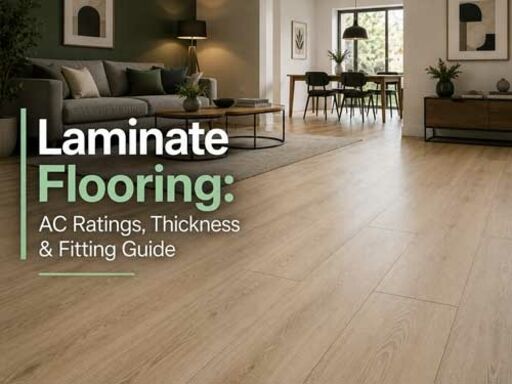
Laminate is a photographic wood-look layer bonded to a dense fibreboard core, protected by a clear resin wear layer, and almost always fitted as a floating click floor rather than glued down. It's one of the most budget-friendly ways to get a wood look, but the numbers on the box (AC rating, thickness, core density) matter more here than the surface pattern, since they're what actually determine how it holds up.
AC ratings, explained
Laminate is graded on the AC scale (AC1 to AC5), which measures resistance to wear, impact, and staining under standardised testing:
- AC1–AC2 – light domestic use, suited to bedrooms and occasional-use rooms.
- AC3 – general domestic use, the standard spec for most living rooms, hallways, and kitchens.
- AC4 – heavy domestic or light commercial use, a sensible upgrade for busy households with pets or kids.
- AC5 – heavy commercial use; more durability than most homes need, but common in rental properties expecting hard wear.
Higher AC doesn't necessarily mean a better-looking floor, just a tougher one, so it's worth matching the rating to the room rather than defaulting to the highest number available.
Thickness and what it changes
- 7mm–8mm – budget end, fine for low-traffic rooms, but can feel and sound hollow underfoot.
- 9mm–10mm – the most common domestic range, a reasonable balance of cost, sound, and durability.
- 12mm+ – thicker boards feel closer to real wood underfoot, handle minor subfloor imperfections better, and generally carry a longer warranty.
Thickness also affects how well a floor copes with an uneven subfloor: thicker boards bridge small dips more forgivingly than thin ones.
Moisture and water-resistant ranges
Standard laminate is not designed for wet rooms, since the fibreboard core swells if it takes on water. Some ranges are sold as water-resistant, with a treated core and tighter click joints that cope with spills if wiped up promptly, but even these aren't a substitute for genuinely waterproof flooring like SPC in a bathroom or utility room. If the room sees regular splashing rather than occasional spills, an LVT/SPC floor is usually the safer choice.
Fitting basics
- Let the laminate acclimatise in the room for the period stated on the packaging, typically 48 hours, before fitting.
- Check subfloor flatness; laminate is more forgiving than LVT but still shows up significant dips as clicking or movement underfoot.
- Fit a suitable underlay, both for comfort and to manage minor subfloor irregularities and impact sound, especially in flats.
- Leave an expansion gap around the room's perimeter, since laminate expands and contracts with temperature and humidity; skipping this is one of the most common causes of buckling.
Our underlay and insulation range covers options for sound reduction and subfloor smoothing, and our damp proofing and levelling range is worth checking if you're fitting over concrete.
Underfloor heating
Most laminate can go over underfloor heating, but check the maximum surface temperature rating first, and avoid unusually thick boards over UFH since they insulate against the heat reaching the room. Thinner, UFH-rated laminate transfers heat more efficiently than a thick 12mm board.
Common mistakes worth avoiding
- Choosing the lowest AC rating available for a busy family hallway.
- Skipping the expansion gap around the room's edge.
- Fitting standard (non-water-resistant) laminate in a kitchen without checking spill tolerance.
- Fitting straight from a cold van without letting the boards acclimatise first.
See it before you order
Laminate's wood-look printing has come a long way, but grain pattern and sheen level still vary a lot between ranges. Order a few free samples and view them in your room's actual light before committing. If you'd rather have it fitted for you, our fitting service covers laminate installation across London.
Frequently asked questions
What AC rating do I need for a family kitchen? AC4 is a sensible choice for a busy kitchen with kids or pets; AC3 is generally enough for lighter domestic use.
Can laminate flooring get wet? Standard laminate isn't designed for sustained moisture. Water-resistant ranges tolerate spills wiped up promptly, but for a genuinely wet room, SPC or WPC vinyl is the more reliable choice.
Do I need an expansion gap around the whole room? Yes. Laminate needs a small gap (usually covered by skirting or beading) around the entire perimeter, including at doorways, to allow for natural expansion and contraction.
Is thicker laminate always better? Not necessarily. Thicker boards generally feel more solid and handle minor subfloor dips better, but a well-rated 8mm-10mm board is often plenty for a typical domestic room.
Browse the full range of laminate flooring to compare AC ratings, thicknesses, and finishes in stock now.