Moisture and Humidity Requirements for Herringbone Oak Flooring on Concrete Subfloors
Before installing herringbone oak flooring on a concrete subfloor, moisture levels in both the concrete and the ambient environment must fall within strict limits. Failure to achieve correct readings before installation leads to warping, cupping, bowing, and delamination — problems that are expensive to fix after the fact. This report covers the specific thresholds for concrete subfloor moisture, ambient room conditions, and testing methods.
Concrete Subfloor Moisture Limits
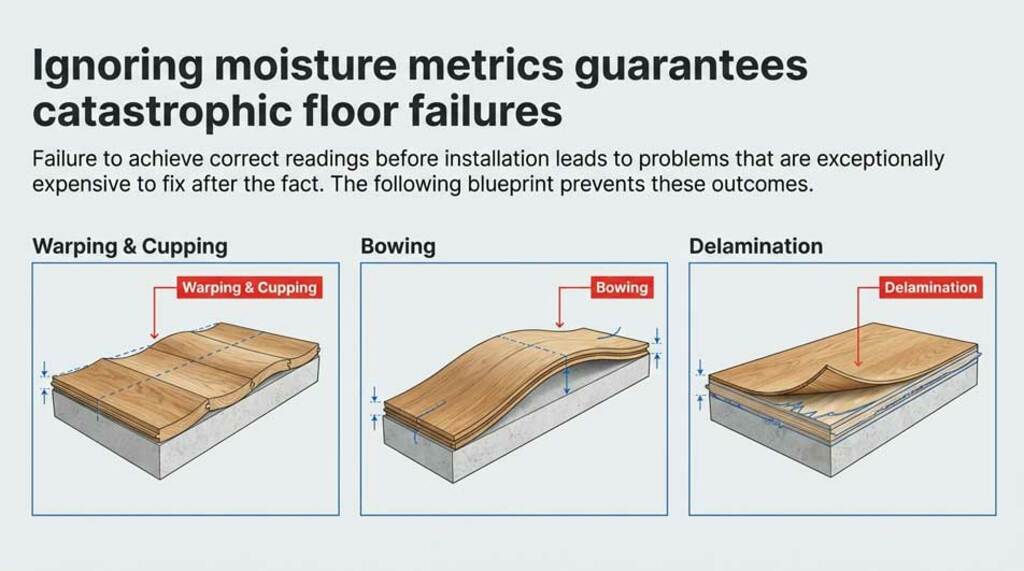
The critical metric is the concrete's moisture content. Multiple flooring manufacturers and the UK standard BS 8201 converge on these thresholds:
| Test Method | Maximum Reading for Concrete/Cement Screed | Maximum for Anhydrite Screed |
|---|
| Calcium Carbide (CM) method | ≤ 2.0% MC (some specify 2.5% CM) | ≤ 0.5% MC |
| Relative Humidity (RH) hood test (BS 8201) | ≤ 75% RH | — |
| RH for glue-down engineered flooring | ≤ 65% RH | — |
| Non-destructive moisture meter (e.g. Tramex) | ≤ 4% MC | — |
Key Points
- BS 8201 specifies a maximum of 75% relative humidity or 5% moisture content for a concrete slab. However, this is considered too high for kiln-dried timber in direct contact with concrete. Industry best practice recommends around 35–40% RH (equating to approximately 2% moisture content) when bonding wood directly.
- Most herringbone oak flooring manufacturers specify a maximum of 2% moisture content using the calcium carbide method for concrete screeds. This is the most widely cited threshold across flooring suppliers.
- For engineered oak flooring being glued down to concrete, the subfloor relative humidity should ideally be below 65% RH. For floating installations, the standard 75% RH threshold applies.
- When underfloor heating is present, requirements are stricter — typically 1.8% MC for concrete and 0.5% for anhydrite screeds.
Ambient Room Conditions
Beyond the subfloor itself, the room environment during installation must be controlled:
- Ambient temperature: approximately 18–21°C
- Relative humidity of the room: between 45–65%, with 55% being ideal
- These conditions should be established and maintained for at least 1 week for plywood subfloors and 2 weeks for concrete subfloors before installation begins.
- Post-installation, the same temperature and humidity parameters should be maintained at all times. Extremely dry conditions (low RH during winter months with heavy heating) can cause boards to shrink and gap.
Flooring Acclimatisation

Engineered herringbone oak boards must be acclimatised to the room before installation. Boards should be stored in the room where they will be laid for a minimum of 2–7 days before installation. The flooring itself is typically kiln-dried to a moisture content of 8% ± 2%. Before installing, the moisture content of the boards should be within 2–3% of the subfloor and environment readings.
Concrete Drying Times
New concrete must be given adequate time to cure and dry before any flooring is installed:
- Minimum 60 days curing time for new concrete slabs.
- As a rule of thumb, allow 1 day per mm of screed depth for screeds up to 60mm thick.
- For screeds over 60mm, allow 2 days per mm for thickness above the 60mm mark. A 70mm screed could therefore take up to 140 days.
- Temperature, ventilation, and ambient humidity all affect drying times significantly.
Testing Methods
Several established methods exist for checking concrete moisture, each with different advantages:
Calcium Carbide (CM) Test
A sample of the screed is removed, crushed, weighed, and placed into a pressure vessel with calcium carbide. The gas pressure produced indicates moisture content. This is the most commonly specified method by flooring manufacturers in the UK and Europe. A reading of ≤ 2.0–2.5% CM indicates the floor is dry enough for wood flooring.
BS 8201 Relative Humidity Hood Test
An insulated, impermeable box is sealed to the concrete surface for at least 72 hours. A hygrometer probe reads the relative humidity inside the box. Readings are taken every 24 hours until two consecutive readings match. If the result is ≤ 75% RH, the slab is considered acceptably dry.
Non-Destructive Electronic Meters
Devices like the Tramex Concrete Moisture Meter give instant surface readings and are useful for initial screening and creating a moisture "map" of the slab. These should be followed up with CM or RH testing for confirmation.
Plastic Sheet Method (ASTM D 4263)
A plastic sheet is taped to the concrete for 72 hours, after which the relative humidity underneath is measured. A maximum of 80% RH is recommended for wood flooring. This is a rough qualitative method and less precise than the CM or hood methods.
Damp Proof Membranes

If moisture readings are above acceptable levels, a damp proof membrane (DPM) may allow installation to proceed:
- For floating installations, a PE vapour barrier of at least 0.2mm thickness must be installed, with joints taped and overlapping by a minimum of 15cm.
- For glue-down installations, a liquid DPM (paint-on type) can be applied if the CM reading is between 2% and 4% and the screed is 60mm thick or less.
- All ground-level or below-grade concrete subfloors must contain an effective DPM regardless of moisture readings.
Subfloor Flatness
While not a humidity metric, subfloor flatness is equally critical: the concrete must be level to within 3mm over 1 metre (or 2 metres, depending on the manufacturer) in any direction. Any irregularities beyond this tolerance must be levelled with a suitable compound before installation.
Conclusion

For herringbone oak flooring on concrete, the core requirement is a subfloor moisture content of no more than 2% MC (calcium carbide method) or 75% RH (hood test), with glue-down installations ideally requiring ≤ 65% RH. The room should be maintained at 18–21°C and 45–65% relative humidity both during and after installation. Always test concrete with appropriate instruments — never rely on visual assessment alone — and allow new screeds a minimum of 60 days to cure before testing.