Can You Use LVT or SPC Flooring with Underfloor Heating?
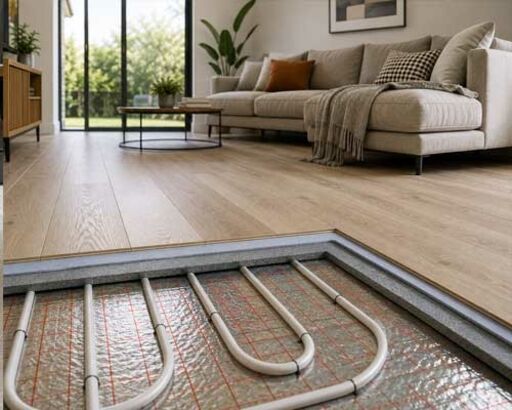
Underfloor heating and vinyl flooring make a good pair. LVT (Luxury Vinyl Tile) and SPC (Stone Plastic Composite) flooring are both suitable for use with underfloor heating, whether you have an electric heated floor or a water-based system. The floors are thin, dense and stable, so heat reaches the surface quickly and evenly.
There are rules, though. The floor surface has to stay at or below 27°C, the heating needs to come up slowly after fitting, and the underlay and adhesive have to be rated for the job. This guide covers which systems work, how thick your floor can be, whether to choose click or glue-down, and the mistakes that lead to gapping and warping.
Can You Put Underfloor Heating Under Vinyl Flooring?
Yes. Vinyl flooring is one of the easier coverings to use with underfloor heating, provided the product is approved for it. “Vinyl flooring” is a broad term, and it usually means one of three things:
- LVT (Luxury Vinyl Tile): flexible planks or tiles, fitted either click-lock or glued down.
- SPC (Stone Plastic Composite): rigid-core vinyl planks with a limestone-composite core, almost always click-lock.
- Sheet vinyl and lino: rolled flooring bonded down in one piece (covered in its own section below).
The same basic rule applies to all of them: keep the surface temperature at 27°C or below and check that the product datasheet confirms it’s suitable for underfloor heating. Vinyl has low thermal resistance, so it responds quickly when the heating comes on and the room warms up without much delay.
Suitability is decided product by product, not for the material as a whole, so check the specification of each floor before you order. You can browse our full vinyl flooring range to compare options.
LVT and SPC: What Makes Them UFH-Friendly

Both floor types are built with thin, dense layers that let heat travel up to the surface efficiently, so a room feels warm quickly and evenly.
SPC has a rigid limestone-composite core. It’s dense, carries heat well and holds its size even in rooms where the temperature swings. LVT is more flexible, but it’s just as effective when it’s fitted correctly over a heated subfloor.
- Low thermal resistance: heat passes through faster than it does through most traditional floor coverings.
- Stable construction: resists warping or gapping under gentle heating cycles.
- Thin profile: lets heat through faster than thicker floors like solid hardwood.
That combination makes them a sensible choice for homes where comfort and running efficiency both matter.
LVT vs SPC: Which Is Better for Underfloor Heating?
Neither is better across the board. Both are types of luxury vinyl flooring, and both are suitable for underfloor heating. The difference is in the core, and that affects how they feel, how they’re fitted and which subfloors they suit.
| | LVT | SPC |
|---|
| Core | Flexible vinyl | Rigid limestone-composite core |
| Feel underfoot | Softer, with a little give | Firmer and more solid |
| Stability with temperature changes | Good when installed correctly | Very good, resists movement |
| Fitting method | Click-lock or glue-down | Almost always click-lock |
| Subfloor | Needs a very flat surface, especially in thin glue-down tiles | Copes with minor imperfections slightly better, but still needs a flat, dry base |
| Often paired with | Water-based systems (glue-down) | Electric systems (floating click floors) |
So is SPC the same as LVT? Not quite. SPC is a rigid-core version of luxury vinyl, while “LVT” usually refers to the more flexible tiles and planks. If you’re fitting over a screed with a water-based system, glue-down LVT is a natural fit. If you want a quicker, floating install with a firmer feel, SPC is hard to beat.
Important Factors to Consider

LVT and SPC are compatible with underfloor heating, but a few technical requirements need to be followed to avoid damage to the floor or the heating system.
- Maximum temperature: the surface temperature of the floor should not exceed 27°C. Going above it can cause warping or delamination.
- Even heat distribution: avoid thick rugs or furniture that block heat in one area, because that leads to hot spots and stress on the material.
- Product thickness: thinner floors let heat through faster than thicker ones (see the thickness section below).
- Manufacturer guidelines: always check the datasheet to confirm the floor is tested and approved for use with underfloor heating.
Stick to these, and you’ll get safe, efficient heat and a floor that stays stable through the seasons.
How Thick Can LVT Be Over Underfloor Heating?
Most LVT and SPC floors are between 4mm and 6.5mm thick, and floors across that whole range are used over underfloor heating. What matters more than the thickness of the planks alone is the total thermal resistance of the build-up: the floor, any backing attached to it, and any underlay beneath. Thinner floors let heat through faster. Thicker ones take a little longer to warm up, then hold the heat a bit longer.
| Thickness | What to expect | Suits |
|---|
| Around 4mm | Fastest response to the heating | Renovations where floor height is tight, or slim glue-down and click floors |
| Around 5mm | A good balance of warm-up speed and stability | Most living rooms, hallways and kitchens |
| 6mm to 6.5mm | Slightly slower to warm, but very rigid | Rigid-core SPC in larger or open-plan rooms |
Check whether the thickness on the datasheet includes an attached underlay. If it does, that backing is part of what the heat has to pass through, so it counts towards the total.
Types of Underfloor Heating Systems That Work Best

Both electric and water-based (hydronic) systems work with LVT and SPC flooring, as long as installation is done correctly. The right one depends on your subfloor, budget and the size of the area you’re heating.
- Electric systems: heating mats or cables fitted under the floor covering. They suit smaller areas like bathrooms, kitchens and home offices, and they’re easier to fit in a renovation.
- Water-based systems: warm water circulates through pipes, usually set in the screed. They’re better for larger spaces and whole-house heating, but need more work up front.
Click-lock LVT and SPC floors with built-in underlay are often used with electric systems, while glue-down variants are commonly paired with water-based ones. Whichever you choose, follow both the flooring manufacturer’s and the heating manufacturer’s compatibility instructions.
Can You Use Electric Underfloor Heating Under Vinyl Flooring?
Yes. Electric heated floors work well under vinyl, LVT and vinyl plank. They’re the usual choice for a single room, an extension or a bathroom where digging up a screed isn’t realistic. A few points make the difference between a floor that heats evenly and one that gives trouble:
- Mats or cables: mats are quicker to lay in regular rooms, while loose cables suit awkward shapes and rooms with lots of obstacles.
- Floor sensor and thermostat: use a thermostat with a floor probe and set the limit at 27°C or lower, so the surface can never overheat.
- Keep heat away from fixed units: don’t lay heating under kitchen units or built-in furniture, where heat can build up.
- Bedding the elements: most systems need the mat or cable set in adhesive or a thin layer of levelling compound over insulation board before the floor goes down. For a floating click floor, only lay elements loose beneath it if the heating manufacturer specifically approves that.
- Testing: have a qualified electrician connect the system and test it before and after the floor is fitted.
If you’re unsure how a particular mat pairs with a particular floor, check both datasheets before you buy anything.
Glue-Down or Click LVT: Which Works Better with Underfloor Heating?
Both work. The better choice depends on your heating system, your subfloor and how much disruption you can live with.
| | Click-lock | Glue-down |
|---|
| How it’s fitted | Boards lock together and float over the subfloor | Bonded to the subfloor with adhesive |
| Common pairing | Electric systems and existing floors | Water-based systems in a screed |
| Subfloor preparation | Flat, dry and clean | Very flat and smooth, as bumps show through thin tiles |
| Heat transfer | A little extra resistance if there’s an attached backing | Direct contact, so it responds quickly |
| Adhesive | None needed | Must be approved for underfloor heating |
| Repairs | Planks can often be released and replaced | Individual tiles can be replaced, but it takes more work |
If your heating is already set in a level screed, glue-down gives the most direct heat transfer. If you’re fitting over an existing floor, or you want a faster install, click-lock is the easier route. Click floors float, so leave the expansion gap around the edges that the manufacturer specifies and let the floor move with the heat.
Do LVT and SPC Flooring Need Underlay?

It depends on the floor and the heating system. Many LVT and SPC floors come with an acoustic or thermal backing already attached, and adding a second underlay on top can double up the thermal resistance. Some click systems can even be invalidated by the wrong underlay, so check the flooring manufacturer’s guidance first.
If you do need an underlay, make sure it’s designed for use with underfloor heating. Look for:
- Low thermal resistance: a low tog rating lets heat pass up to the surface. Check the combined figure for the floor and underlay against the heating manufacturer’s limit.
- An underfloor heating rating: use an underlay that states it’s suitable for heated floors, rather than a standard acoustic foam.
- Moisture protection: important over concrete subfloors, to stop condensation getting trapped under the floor.
Browse our range of underlay and insulation for options suited to vinyl flooring.
Can You Put Underfloor Heating Under Lino?
Often, yes. Lino (linoleum) and sheet vinyl can both be laid over underfloor heating, but the rules are tighter than for click LVT. They’re bonded down in one piece across the whole floor, so three things need attention:
- Adhesive: it must be approved for underfloor heating and suit the covering.
- Subfloor flatness: any bump or ridge will show through thin sheet flooring.
- Temperature limit: follow the manufacturer’s maximum surface temperature for that product, which may not match the 27°C used for LVT.
Lino also can’t be repaired one plank at a time. If a section is damaged, the repair is bigger. If you like the idea of a warm, easy-care floor but want simpler fitting and plank-by-plank repairs, click LVT or SPC does the same job with less fuss.
Installation Tips for Optimal Results

Good preparation is what separates a floor that lasts from one that gaps or lifts. Proper preparation and a few specific steps are essential, and skipping them can damage the floor or waste heat.
- Acclimate the flooring: leave the planks in the room for at least 48 hours before installation so they adjust to the room’s temperature and humidity.
- Prepare the subfloor: it must be flat, dry and clean, with moisture levels no higher than 75% RH (relative humidity).
- Use compatible adhesives: for glue-down installs, pick an adhesive approved for underfloor heating, and let it cure for as long as the manufacturer says before the heating goes on.
- Leave expansion gaps: on click floors, keep the gap around the perimeter that the manufacturer specifies.
- Bring the heat up gradually: don’t switch the system on at full power. Raise the temperature slowly, by no more than 5°C per day, until you reach the level you want.
Careful installation extends the life of the floor and lets your heating system run as it should.
Mistakes to Avoid
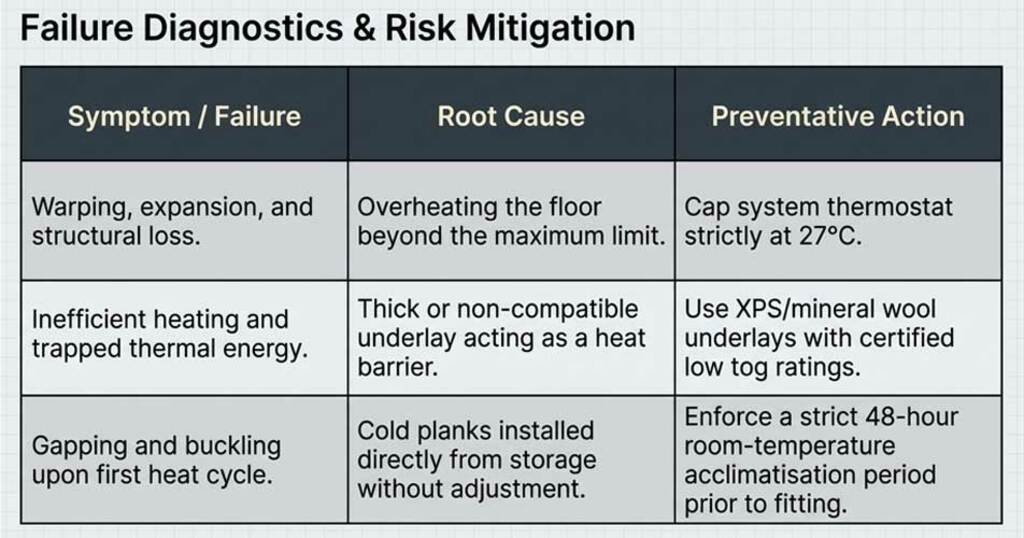
LVT and SPC are compatible with underfloor heating, but a handful of common mistakes cause most of the problems. Here’s what to watch for:
- Skipping product compatibility checks: not every LVT or SPC floor is approved for heated subfloors. Check the datasheet or ask the manufacturer.
- Overheating the floor: a setting above 27°C can make planks expand, warp or lose structural integrity.
- Using the wrong underlay: a thick or non-compatible underlay acts as a heat barrier, cuts efficiency and traps heat that can damage the floor.
- Stacking two underlays: if the floor already has a backing attached, adding another layer can push the thermal resistance too high.
- Ignoring acclimation: cold planks straight from storage can gap or buckle once the floor heats up.
- Heating under fixed units: elements under kitchen units or built-in furniture can overheat with nowhere for the heat to go.
Avoid these and your floor should look good and perform well for years while keeping your heating efficient.
LVT and SPC Flooring Work Beautifully with Underfloor Heating

Fitted properly, LVT and SPC give you style, durability and warm underfoot comfort over underfloor heating. Their low thermal resistance, stability and range of designs make them an easy match for a heated home.
Keep it simple: follow the fitting guidelines, use a compatible underlay and adhesive, and never exceed a surface temperature of 27°C. If you’re unsure about a particular product, ask before you buy.
Explore our full selection of LVT and SPC flooring options to find the right floor for your home. If you need help matching a floor to your heating system, our team can give you personalised advice and product recommendations.
Frequently Asked Questions about LVT and SPC with Underfloor Heating
Is vinyl flooring heat resistant enough for underfloor heating?
Yes, as long as the surface temperature stays at or below 27°C. That’s well within the range a normal underfloor heating system uses to warm a room comfortably. The risk only comes from setting the system too high.
Will LVT feel warm underfoot?
Vinyl feels warmer underfoot than cold surfaces like stone or ceramic tile, and with underfloor heating switched on it warms up quickly. SPC feels a little firmer, LVT a little softer, but both carry heat to the surface efficiently.
Can I fit LVT or SPC over underfloor heating on a concrete subfloor?
Yes. The subfloor needs to be flat, clean and dry, with moisture no higher than 75% RH. Over concrete, use an underlay with moisture protection so condensation can’t get trapped beneath the floor.
Is electric or water-based underfloor heating better under vinyl?
Both work. Electric systems suit smaller rooms and renovations because they’re quicker and cheaper to fit. Water-based systems make more sense for larger areas and whole-house heating, and they’re usually paired with glue-down floors.
Can I use rugs and furniture on a heated vinyl floor?
Yes, but avoid thick rugs and anything that covers large areas of the floor for long periods, since they trap heat and can create hot spots. Thin rugs and normal furniture are fine.
How long should I wait before switching the heating on after fitting?
For glue-down floors, wait until the adhesive has cured for the time the manufacturer specifies. Then bring the heating up gradually, by no more than 5°C per day, until it reaches the temperature you want.